Insights
Notes on financial planning for academics and physicians.
Practical analysis of the financial structures, decisions, and trade-offs that come with academic and medical careers.

Academic tax strategy
What the 2026 Midterm Elections Mean for Tax and Financial Planning
The 2026 midterm elections shifted the balance of power in Congress but did not change existing tax law. Here is what academics and physicians need to know about planning under the current framework.
Year-End Financial Checklist for Pre-Retiree Faculty: 2026 Edition
Pre-retiree faculty face a cluster of hard deadlines before December 31: contribution limits rose, a new Roth catch-up rule took effect, and RMD penalties remain as steep as ever. Here's what to review now.
SECURE 2.0 Section 204: Partial Annuitization and Required Minimum Distributions
Section 204 of SECURE 2.0 may allow certain annuity payments to count toward the RMD calculated on both the annuity and the remaining eligible account balance. The opportunity is meaningful, but the plan, valuation, and administrative requirements matter.
When a Long-Term Care Insurance Company Drops the Ball, What Should You Do? Originally published on Kiplinger.com as part of Kiplinger Adviser Intel.
When a long-term care insurer drops the ball, it is easy to let frustration drive the decision. But whether the company handled things well and whether the coverage still has value are two different questions.
Why I Wrote Getting to Emeritus
Faculty careers run longer, peak later, and sit inside plan structures that have no clean corporate analog. The standard retirement playbook was built for a different life. Here is why I wrote a book for the one academics actually live
TIAA Traditional: The Contract You Hold Decides What You Can Do
Two professors at the same university, both with $600,000 in TIAA Traditional. One can move the entire balance tomorrow. The other can't move any of it in a lump sum, and unwinding the position takes nine years. Same product, same statement line, different contract. Here is the whole picture, contract by contract, including the rate tables and the nine-year decision most people meet with two years of runway.
The 457 Bridge: How Public Employees Retire Before 59½ Without the Penalty
Money in a governmental 457(b) plan can be withdrawn after you separate from service at any age with no 10% early-withdrawal penalty.
The Yale Faculty Phased Retirement Plan: What to Decide Before You Sign
Half the workload, full pay in year one. It's a good program, and the commitment to retire can't be undone once you sign. The salary schedule is the part everyone knows. The YURAP contributions you give up, the health premiums that don't step down, and the year you place your triennial leave are the parts that quietly decide the outcome.
The $10,000 Rule That Decides When Your Retiree Health Coverage Starts: What UConn and CSCU Employees Need to Know
Your state retiree health coverage doesn't start automatically. It starts when you establish a $10,000 lifetime annuity, within 60 days of retirement. Married? One more election inside that decision matters even more.
Understanding YURAP: A Complete Guide to the Yale University Retirement Account Plan
Most Yale faculty and staff know YURAP exists. Far fewer know how it actually works. This guide walks through the whole plan — what Yale contributes, what you control, the legacy TIAA contract rules, and the deadlines that matter.
Proximity Matters
An annual review is really a conversation about one day. What changed when we moved to quarterly contact, what our own clients told us, and the question every faculty member should ask their adviser
The YURAP Yale Target-Date Plus Service, Explained
Most Yale faculty who never picked their own investments are in the Target-Date Plus Service, and it is a genuinely good default. But it only manages the money inside the model, and by the time you are nearing retirement, there is often a lot it cannot see. Here is what you own, why the TIAA Traditional piece is better than people realize, and what is worth checking before you retire.
Academic Retirement Planning: What Faculty Actually Need to Decide
Most faculty spend decades saving and almost no time on the harder question: how does all of that become income? If you're within five to ten years of retirement, these are the decisions that tend to get postponed, and are expensive to get wrong.
RA, GRA, RC, or RCP? Why Your TIAA Contract Type Decides What Happens When Your University Leaves TIAA
Your university says you don't need to do anything when it leaves TIAA. For some faculty that's true. For others it's the most expensive sentence in the email. The difference comes down to one detail: which TIAA contract type you hold.
When Your University Drops TIAA
The transition email says you don't need to do anything — and whether that's true depends on one fact most faculty can't name: which TIAA contract type they hold. Legacy contracts (RA, GRA, SRA, GSRA) are participant-owned and can only be frozen, never forced out. RC and RCP contracts are employer-held, and the plan sponsor has the right to transfer the entire TIAA Traditional balance on a 60-month payout. Same announcement, two completely different outcomes.
The First Year of Retirement: What Professors Should Expect — and Do
Most faculty are prepared for the financial mechanics of retiring and unprepared for almost everything else. The first-year money moves, the IRMAA appeal nobody files for you, and the harder part no spreadsheet covers.
Retiring Before 65: How Professors Bridge the Health Insurance Gap to Medicare
Health insurance, not the portfolio, is what most often decides when a professor actually retires. The four realistic paths from employer coverage to Medicare, and why gap-year income planning can be worth tens of thousands.

The WEP/GPO Repeal at UConn, UConn Health, and UMass: Who Gets Money Back — and Who Still Has to Ask
The Social Security Fairness Act restored benefits that WEP and GPO took from public-university retirees — and most payments arrived automatically. But if you or your spouse never applied because GPO would have zeroed the benefit, the money is still sitting at SSA, and the clock on retroactivity is running. Here's the campus-by-campus map for UConn, UConn Health, and UMass.
Your TIAA Options at Retirement: A Decision Guide for Professors
Most professors' retirement savings are at TIAA, and most have never had their options explained. A decision guide covering contract types, the loyalty bonus, rollover trade-offs, and the seven questions that change the answer.
When the News and the Market Disagree: A Guide for Faculty and Physicians Near Retirement
Every few years, the world produces a moment when the headlines say one thing and your portfolio says another. We are in one of those moments right now.
The Bucket Strategy for Professors: How to Never Sell at the Bottom
The failure mode behind most retirement disasters is the same: selling growth assets at the bottom to pay the bills. The three-bucket fix, sized for academic income floors, plus the TIAA contract rule that catches professors off guard.
What Bonds Did in 2022 — and What TIAA Traditional Did Instead
The 60/40 portfolio's worst year on record taught professors something important: "bond fund" and "safe" are not the same word. A fixed income guide for faculty and physicians with TIAA accounts.
Unequal Inheritance: How to Tell Your Children Before Your Estate Plan Does
When children learn about an unequal inheritance after a parent's death, they receive it while grieving, with no chance to ask questions. Here's how to have the conversation now — values first, differences addressed directly — and why the beneficiary forms on your TIAA, YURAP, or ARP accounts may matter more than the will.
Lifetime Giving vs. Inheritance: When Should You Transfer Wealth to Your Children?
The average American inherits in their early 50s — decades past the years when money changes a trajectory. The case for giving with a warm hand, the reasons to wait, and the middle path most families miss
Supporting Adult Children Without Creating Dependence: When Is Helping Too Much?
Most parents carry a question they rarely say out loud: am I helping too much, or not enough? Part one of a five-part series on gifting, fairness, and family responsibility — the difference between relief and rescue, how repeated help changes incentives, and why "I can afford it" is not the same as "I should do it."
Why Some Retirement Income Plans Bend and Others Break
The most damaging retirement decisions are usually the forced ones.
Stress Testing Your Retirement Plan: Where the Spreadsheet Breaks First
Rigid spending, evaporating risk tolerance, and compressed timelines — a buyout at 62 instead of retirement at 67. Where retirement plans actually break, and the design choices that make them hold
The Average Returns Myth: The Retirement Math Professors Miss
Two portfolios can earn identical average returns and end up in dramatically different places. The assumption buried in most retirement projections — and the better questions to ask instead.
Five to Ten Years From Retirement? Here's What to Protect First
Most retirement damage doesn't happen in retirement. It happens quietly in the five to ten years before it, when portfolios drift toward risk and nobody's watching. Four moves professors can make now to protect what they've built.
Sequence of Returns Risk: Two Professors, $400,000 Apart
Two professors, same careers, same savings, same $1 million at retirement. One ran out of money. The other left an inheritance. The only difference was timing, and it has a name: sequence of returns risk.
What If This Time Really Is Different? Steelmanning the AI Bull Case
After arguing that market concentration creates risk — and that your psychology makes it worse — intellectual honesty demands the third piece: the strongest version of the argument worth being skeptical of. The genuine bull case for tech dominance, the four conditions it depends on, and what the Nifty Fifty and Cisco say about "permanent" moats.
Target Date Funds: The Hidden Concentration Inside Your "Diversified" 403(b)
You picked a target date fund: set it and forget it. But that "diversified" fund may have quietly concentrated your retirement savings in the same seven companies that dominate the S&P 500. Here is what is actually under the hood.
The Behavior Gap: Why Smart Investors Underperform Their Own Investments
In 2024 the S&P 500 returned 25.05% and the average equity investor captured 16.54% — an 848-basis-point gap in a year when everything went right, the fifteenth straight year of underperformance. The five cognitive biases behind the gap, why intelligence makes some of them worse, and the four boring practices that actually close it.
The S&P 500's Rotating Door: What 75 Years of Fallen Giants Means for Your 403(b)
The biggest risk to an index investor was never that the market fails. It's that the market succeeds with a completely different set of winners than the ones you're holding, at the moment you start needing the money.
The Roth-Only Catch-Up Rule Is Here: A 2026 Tax Checklist for Faculty and Physicians
Turning 50 used to mean bigger contributions and a lower tax bill. Under the new Roth-only catch-up rule, higher-earning faculty and physicians get the savings without the deduction — here's how to rebalance around it.
The Practice Retirement: Using a Sabbatical to Test Life After Academia
Retirement calculators can tell you whether the money works. They can't tell you whether the life works. One professor's sabbatical answered the question no spreadsheet could.
Roth Conversions for Professors: The Mistakes That Cost the Most
An economics professor nearly paid 31.5% in taxes to avoid a 15.9% rate. The Roth conversion math most academics get backwards — and the windows when converting actually pays.
Asset Location vs. Asset Allocation: The Difference Most Faculty Overlook
You can have the perfect allocation and still leave money on the table. Asset location, putting the right investments in the right accounts, is one of the few ways to add after-tax value without taking on more risk. Here is how it works.
TIAA Beneficiary Designations: The Form Professors Forget
Sixty to seventy percent of most Americans' wealth transfers through beneficiary forms, not wills. For professors with TIAA accounts across multiple institutions, one outdated form can undo an entire estate plan.
Negotiating an Academic Leadership Contract? Look Past the Salary Line
For presidents, provosts, and deans, salary is the simplest part of a contract. The real risk lives in deferred compensation, vesting schedules, and what happens after the role ends. Four questions to ask before you sign.
Phased Retirement for Professors: The Math Behind the Smartest Year You’ll Ever Work
One to three years of part-time teaching can do three jobs at once: let your TIAA accounts compound untouched, raise your Social Security check permanently, and open the tax window where Roth conversions actually pay.
How Much Can You Safely Withdraw From Your TIAA?
The 4% rule is the standard answer to how much you can withdraw in retirement. For faculty with substantial TIAA balances, it's often the wrong one. Here is a split-income strategy that depends on a feature unique to TIAA.
The Case for Partial Annuitization: Why Annuitizing Less Can Leave More
Most faculty think annuitizing means handing over your money and leaving nothing behind. For many, annuitizing a portion does the opposite, it can leave more. Here is why, and how to find your number.
Should I Annuitize My TIAA?
Most faculty think annuitizing TIAA is a simple yes or no. It is closer to three choices: annuitize, roll over, or wait. Here is how to think it through before you sign anything, and why the older-vintage benefits cannot be recreated once you give them up.
Why I Left TIAA After 17 Years—and What It Taught Me About Serving Clients Well
TIAA is a remarkable institution with a mission I still believe in. So why did I leave after 17 years? The short answer: scale changes what an advisor can do for each client. Here's the longer one — and how it shaped the way we work at Radiant.
The Quiet Erosion of Academic Security: What Faculty Can Do About It
What happens if my department disappears?" A tenured professor's quiet question captures a shift happening across higher education — from academic stability toward professional fragility. The four forces driving it, and the five financial moves that turn realism into a plan instead of a panic.
Politics-Proofing Your Portfolio: Three Filters for a Hyperpartisan Era
Clients on opposite ends of the political spectrum keep arriving at the identical financial mistake: abandoning years of planning over partisan emotion. Three filters — immediate risk vs. noise, political cycles vs. financial goals, values vs. reactions — from a framework first published in Financial Planning.
Department Chair Finances: Three Questions to Ask Before You Step Up or Step Down
The transition out of leadership may be the most underutilized planning window in an academic's career. What chairs at Yale, Rutgers, SUNY, and the UC system tend to miss on the way up, and on the way down.
TIAA, the 403(b), and the 457(b): How Faculty Retirement Benefits Actually Fit Together
Higher education professionals are among the only workers in the country with two full-limit buckets. Most never fill the second one. Many never open it.
Faculty Tuition Benefits: What They Actually Cover — and the Gap They Don’t
One professor's "generous" tuition benefit covered 62% of his son's college costs — leaving an $80,000 gap. What faculty families should know about remission, exchange programs, and the fine print.
Why Academics and Physicians Need a Different Approach to Wealth Management
Your brilliance in the lab or the archive doesn't automatically translate into financial acumen — and the standard wealth-management playbook was written for a career you didn't have. The four structural reasons faculty and physicians need a different approach, and what the right one looks like.
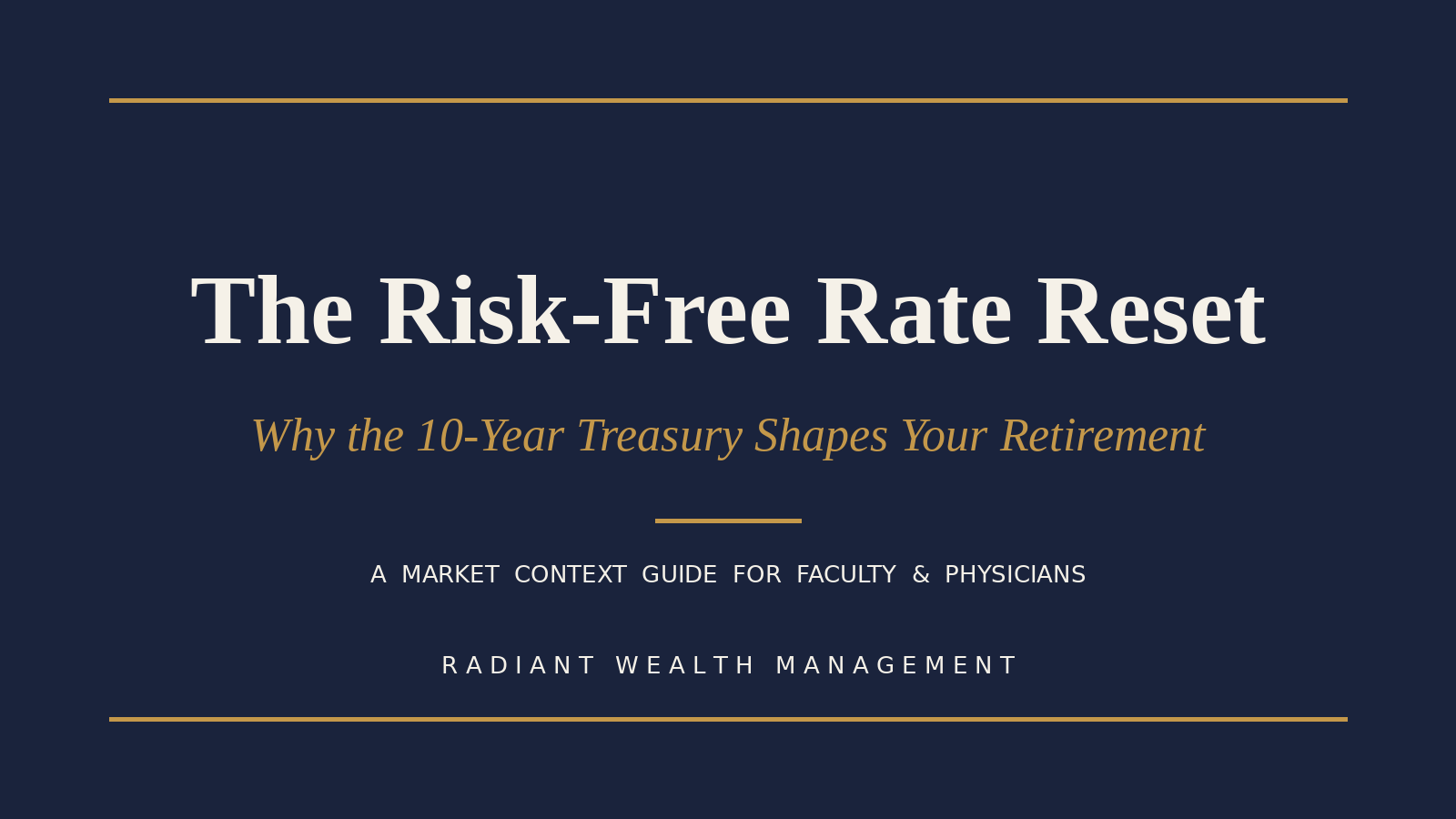
Why the 10-Year Treasury Yield Drives Your Retirement Projections
One faculty member's projected retirement income came in 15% lower with nothing changed but the Treasury yield. The number behind your annuity quotes and your university's budget, and why the low-rate era isn't coming back.
and physicians from












Listing of these institutions does not constitute an endorsement of Radiant Wealth Management by them.
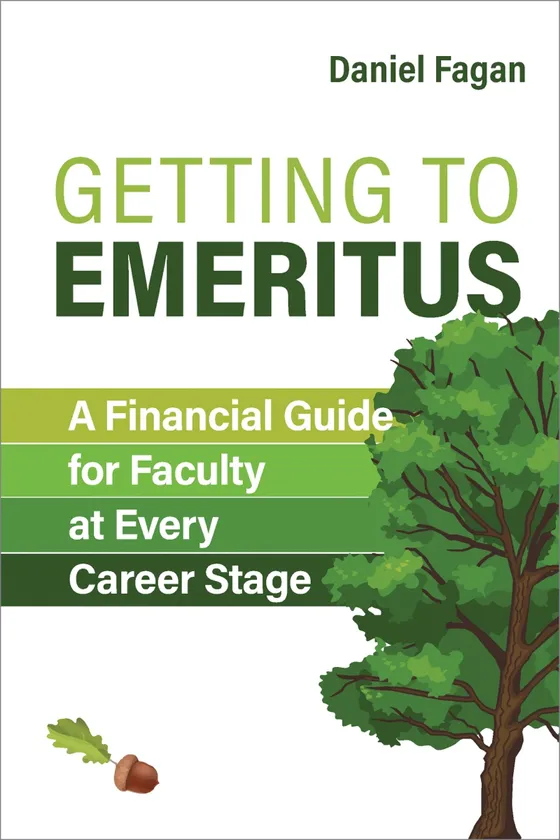
Just released
Johns Hopkins University Press
The Book
Getting to Emeritus
An essential guide to purposeful financial planning for academics.
“Getting to Emeritus is a must-read for faculty, HR leaders, and retirement plan administrators alike. It cuts through the complexities of financial planning with clarity and practical tools that are invaluable for anyone navigating the financial ecosystem of higher education and building long-term wealth.”
Curtis N. Powell
Former Chief Human Resources Officer in Higher Education

Testimonials are based on unique experiences from current clients and are not representative of all client experiences. Testimonials are unsolicited, and no cash or non-cash compensation has been provided. As a result, clients do not receive any material incentives or benefits for providing testimonials. Investing involves risk, including the possible loss of principal and fluctuation of value. Past performance is no guarantee of future results. Additional information about NewEdge Advisors, LLC, is available in its current disclosure documents, Form ADV, Form ADV Part 2A Brochure, and Client Relationship Summary Report which can be found online at the SEC’s Investment Advisor Public Disclosure (IAPD) database at www.adviserinfo.sec.gov
Let's talk about what's next.
Schedule a conversation to see how Radiant can bring clarity to your financial life — with the rigor you'd expect.
- Planning built around academic and medical careers
- Tax, estate, and investment strategies working together
- A dedicated advisor who understands your world
- Transparent fees with no product commissions
Prefer to speak directly? Skip the form and book a call now.