For faculty approaching retirement, the final months of 2026 bring important contribution deadlines, new Roth catch-up requirements, and opportunities to coordinate retirement income and taxes. Here's what deserves attention before December 31.
For faculty within five years of retirement, October through December can be one of the most consequential financial planning periods of the year.
By this stage, years of retirement contributions, institutional benefits, pensions, and accumulated investments are beginning to move toward a common purpose: providing reliable income after an academic career.
But the decisions involved are rarely confined to a single retirement account. A contribution election can affect current taxes. A retirement date can change when distributions become mandatory. A Roth conversion can influence future Medicare premiums. And different retirement plans, sometimes held at multiple universities, may operate under different rules.
The 2026 plan year adds another complication: higher contribution limits and a new mandatory Roth catch-up requirement for certain higher-earning employees.
The following checklist covers the decisions faculty approaching retirement should be reviewing before year-end.
Maximize Your 403(b) and 457(b) Opportunities Before December 31
The 2026 elective deferral limit for 403(b) plans is $24,500, up from $23,500 in 2025. The basic annual limit for eligible 457(b) plans also increased to $24,500.
These are generally separate contribution limits. If your institution offers both a 403(b) and a 457(b), you may be able to defer $24,500 into each, for a combined $49,000 before applicable catch-up contributions.
However, the type of 457(b) plan matters.
Governmental 457(b) plans, commonly available through public universities, have different catch-up provisions from non-governmental 457(b) plans, which are sometimes offered by private universities and nonprofit health systems.
Non-governmental 457(b) plans also carry additional considerations, including employer-creditor exposure and distribution restrictions. Before maximizing contributions, faculty should understand which type of arrangement they have and how those assets will become available in retirement.
Catch-up contributions for faculty age 50 and older
Faculty who reach ages 50 through 59, or age 64 and older, during 2026 may contribute an additional $8,000 to an eligible 403(b) or governmental 457(b) plan, bringing the potential employee deferral to $32,500.
For faculty who reach ages 60, 61, 62, or 63 during 2026, SECURE 2.0 provides an enhanced catch-up limit of $11,250 rather than $8,000.
That brings the potential employee contribution to $35,750 for each eligible plan.
The higher catch-up is available only when the plan permits it. Non-governmental 457(b) plans do not offer these age-based catch-ups.
Eligibility for the enhanced catch-up is determined by the age you attain during the calendar year. Faculty turning 64 in 2026 return to the regular age-50 catch-up limit for the entire year.
Don't overlook the 403(b) 15-year service catch-up
Some longtime faculty may qualify for another contribution opportunity.
Certain 403(b) plans permit employees with at least 15 years of service at an eligible employer to contribute up to an additional $3,000 annually, subject to a $15,000 lifetime maximum and other limitations.
The calculation depends on the employee's service history, previous contributions, and plan provisions. Not every university plan offers the feature.
For faculty who qualify, this provision may provide additional contribution capacity beyond the regular limit. The ordering rules governing this special catch-up and age-based catch-ups should be reviewed carefully.
The special 457(b) pre-retirement catch-up
A separate provision may be available to faculty approaching their plan's designated normal retirement age.
Eligible participants in governmental or non-governmental 457(b) plans may qualify for a special catch-up during the three consecutive calendar years preceding the plan's normal retirement age.
For 2026, this can potentially increase the annual 457(b) contribution limit to $49,000.
But there is an important restriction: the additional amount must be supported by unused deferral capacity from earlier eligible years.
The $49,000 ceiling is not automatic, and the special 457(b) catch-up cannot be combined with the age-based catch-up in the same year. Governmental 457(b) participants eligible for both generally use whichever provision permits the larger contribution.
Review your year-to-date deferrals and payroll elections now. Contribution adjustments can require multiple payroll cycles, and waiting until December may leave too little time to complete them.
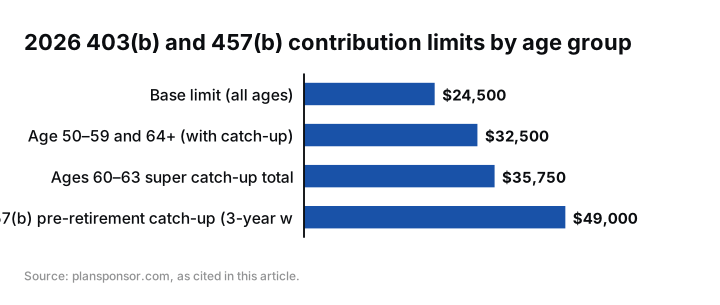
2026 contribution ceilings rise with age, with a narrow super catch-up window for faculty in their early sixties and a separate 457(b) pre-retirement provision.
The New Roth Catch-Up Rule Takes Effect in 2026
One of the most consequential changes under SECURE 2.0 took effect on January 1, 2026.
If your 2025 FICA wages from the employer sponsoring your retirement plan exceeded $150,000, age-based catch-up contributions made to an affected employer retirement plan in 2026 generally must be designated Roth contributions.
These are after-tax contributions rather than traditional pre-tax deferrals.
The relevant compensation measure is generally Social Security wages reported in Box 3 of your 2025 Form W-2, not your adjusted gross income or total household income.
This distinction matters for faculty with outside consulting income, multiple institutional appointments, or employment changes.
The basic $24,500 elective deferral limit is unaffected. Eligible employees may still make those contributions on a traditional pre-tax basis if their plan permits it.
The mandatory Roth treatment generally applies to age-based catch-up contributions, including the higher catch-up available at ages 60–63. The separate 457(b) special pre-retirement catch-up operates under different rules and should not be confused with the age-based provision.
Employees without prior-year FICA wages from the sponsoring employer may be treated differently. Plans that do not offer designated Roth contributions may also be unable to accept age-based catch-ups from employees subject to the Roth requirement.
Faculty should confirm three things with their benefits office:
- Whether their 2025 wages place them above the applicable threshold.
- Whether their institution's plan offers Roth catch-up contributions.
- Whether their 2026 payroll elections and retirement-plan records reflect the required treatment.
This is especially important for faculty who have historically directed all retirement contributions into pre-tax accounts.
The issue isn't simply administrative. Moving catch-up contributions from pre-tax to Roth changes the current-year tax calculation and should be considered alongside expected retirement income and future tax exposure.

Pre-retiree faculty face several irreversible financial deadlines that require action before December 31 each year.
Required Minimum Distributions: Know Which Deadline Applies
For most retirees who are already subject to annual required minimum distributions, December 31 is the deadline for completing their 2026 RMDs.
Generally, individuals born from 1951 through 1959 become subject to RMDs at age 73, while those born in 1960 or later begin at age 75.
However, the rules depend on the type of account and the individual's circumstances.
Traditional IRAs generally require distributions beginning at the applicable statutory age, whether or not the owner is still working.
Employer-sponsored retirement plans, including many 403(b) arrangements, may allow participants who continue working beyond RMD age to postpone distributions until retirement, subject to plan provisions and applicable ownership restrictions.
Certain pre-1987 403(b) balances may also qualify for special RMD treatment.
For those taking their first RMD, the deadline can generally be extended to April 1 of the following calendar year.
That flexibility can create a tax-planning problem.
A retiree who delays a first RMD for 2026 until April 1, 2027 will generally also need to take the regular 2027 RMD by December 31, 2027.
Two taxable distributions in the same calendar year could increase marginal tax exposure, affect the taxation of Social Security benefits, or contribute to higher future Medicare premiums.
For that reason, the decision to delay a first RMD should be evaluated rather than treated as an automatic advantage.
The cost of missing an RMD
If a required distribution is not completed by the applicable deadline, the IRS may impose an excise tax equal to 25% of the shortfall.
Under SECURE 2.0, that tax can be reduced to 10% when the shortfall is corrected within the applicable correction period. The IRS may also waive the tax when the failure resulted from reasonable error and appropriate corrective steps are taken.
Even with those relief provisions, avoiding the problem is preferable.
Faculty who have retirement accounts at multiple institutions should confirm which accounts are subject to RMDs, how those requirements are calculated, and whether the distributions have actually been completed.
The aggregation rules differ between IRAs, 403(b) accounts, and other employer-sponsored plans. An RMD generally cannot simply be taken from whichever retirement account is most convenient.

The December 31 deadline for required minimum distributions is firm and carries a substantial penalty for missed withdrawals.
Qualified Charitable Distributions: An Opportunity for Charitably Inclined Faculty
For faculty who are at least age 70½, Qualified Charitable Distributions can provide an especially useful connection between retirement planning and charitable giving.
A QCD allows an eligible IRA owner to transfer funds directly from an IRA to a qualified charitable organization.
For 2026, the annual QCD exclusion limit is $111,000 per eligible IRA owner.
The amount that otherwise would have been taxable can generally be excluded from income. A properly executed QCD can also satisfy all or part of an IRA required minimum distribution.
That means someone who is already planning to support a university, scholarship fund, educational foundation, or another eligible charitable organization may be able to accomplish the gift without first recognizing taxable IRA income.
The exclusion can be particularly valuable because it may help manage adjusted gross income, with potential implications for Medicare premiums and other income-sensitive tax calculations.
There are important procedural requirements.
The distribution generally must be paid directly from the IRA to the qualified charity. Taking a personal IRA distribution and subsequently donating the proceeds does not create a QCD.
Donor-advised funds and certain supporting organizations are not eligible recipients, and QCDs cannot be used to obtain a second charitable deduction for the same amount.
A QCD also cannot retroactively offset an RMD that has already been distributed.
To count for the 2026 tax year, the qualifying distribution must be completed in 2026. Arrangements should be made sufficiently early to allow the custodian and charity to process the transaction.
For faculty who are charitably inclined, this is one of the more practical year-end planning opportunities worth reviewing.
Tax and Income Positioning Before Year-End
The final quarter provides an opportunity to develop a reasonably complete estimate of annual taxable income.
For faculty approaching retirement, that estimate should include more than university salary.
Potential sources include pension payments, TIAA annuity distributions, required minimum distributions, consulting income, investment income, and any other taxable retirement distributions.
The goal is to understand how these income sources interact with marginal tax brackets, Medicare premium thresholds, and other tax provisions.
Medicare IRMAA considerations
Medicare's Income-Related Monthly Adjustment Amount, commonly called IRMAA, is generally determined using modified adjusted gross income from two years earlier.
That means 2026 income will ordinarily influence Medicare Part B and Part D premiums in 2028.
A faculty member planning to retire in 2027 may have a meaningful income reduction after leaving full-time employment, but a high-income year immediately before retirement can continue affecting Medicare premiums.
A work-related reduction in income may qualify for an IRMAA reconsideration through Social Security. That possibility should be incorporated into the planning process rather than assuming every surcharge is unavoidable.
The point is not necessarily to minimize income in every year. It is to understand the consequences of accelerating or deferring income while evaluating the broader retirement plan.
Roth conversion opportunities
Roth conversions can also deserve attention before December 31.
Faculty expecting substantially lower taxable income after retirement may find favorable conversion opportunities in future years. Others may benefit from converting a portion of pre-tax retirement assets before RMDs begin.
Whether a conversion makes sense depends on current tax brackets, anticipated future income, available cash to pay conversion taxes, state taxation, Medicare considerations, and the expected use of the assets.
A conversion completed in 2026 cannot later be recharacterized back into a traditional IRA.
That makes the decision particularly important to evaluate before execution.
For faculty approaching retirement, the strongest approach is generally to evaluate Roth conversions as part of a multiyear tax strategy rather than simply converting whatever amount appears to fit within the current year's tax bracket.

Year-end tax positioning requires a full-picture review of income sources that affect Medicare premiums and bracket placement.
A Resource Written Specifically for Faculty
The decisions described above are not unique because academics face different tax laws. They are different because academic careers frequently involve benefit structures and professional circumstances that conventional retirement planning resources do not fully address.
Faculty may accumulate retirement accounts at several universities, receive benefits through both 403(b) and 457(b) plans, participate in institution-specific pension arrangements, or maintain TIAA contracts with different investment and distribution provisions.
Add consulting work, sabbaticals, delayed career earnings, and transitions from full-time teaching into emeritus status, and the need for coordinated planning becomes clear.
Getting to Emeritus: A Financial Guide for Faculty at Every Career Stage, written by Daniel Fagan and published by Johns Hopkins University Press on August 25, 2026, addresses these issues directly.
Fagan, co-founder and managing partner of Radiant Wealth Management, spent 17 years advising faculty through TIAA before establishing an independent advisory firm focused on academics, physicians, and other professionals.
Drawing on that experience, the book examines financial decisions across the academic career, from graduate school and early faculty appointments through retirement and estate planning.
It addresses the structure of academic retirement benefits, investment allocation, tax-efficient planning, institutional transitions, healthcare planning, and the challenge of building a sustainable retirement income strategy.
For faculty approaching retirement, the book provides a broader framework for evaluating the decisions that often become concentrated in the final years of an academic career.
Getting to Emeritus is available through Johns Hopkins University Press and booksellers.
Common Questions
Can I contribute to both a 403(b) and a 457(b) at my university?
Yes, potentially. The two plans generally have separate basic deferral limits, allowing up to $24,500 in employee contributions to each for 2026.
Additional catch-up contributions may be available depending on age and plan type.
However, governmental and non-governmental 457(b) plans have different provisions. Faculty should confirm their eligibility, employer contributions, and applicable plan restrictions before making elections.
Who qualifies for the SECURE 2.0 super catch-up in 2026?
Employees who turn 60, 61, 62, or 63 during 2026 may qualify for the enhanced $11,250 age-based catch-up in eligible 403(b) and governmental 457(b) plans.
The maximum basic employee deferral plus enhanced catch-up is $35,750 per eligible plan, assuming sufficient compensation and plan authorization.
Non-governmental 457(b) plans do not offer the age-based super catch-up.
Does the mandatory Roth catch-up requirement affect everyone earning more than $150,000?
No.
For 2026, the general test is whether an employee had more than $150,000 in applicable FICA wages from the sponsoring employer during 2025.
The requirement applies to covered age-based catch-up contributions, not automatically to the employee's entire retirement contribution.
Individual circumstances and plan provisions matter, particularly for faculty with multiple employers or unusual compensation arrangements.
What happens if I miss an RMD deadline?
The IRS may assess an excise tax equal to 25% of the amount not distributed.
That amount can be reduced to 10% through timely correction, and a waiver may be available when the failure resulted from reasonable error and corrective action is taken.
The specific deadline depends on whether the distribution is a first-year RMD and whether an employer-plan exception applies.
Can a Qualified Charitable Distribution satisfy an RMD?
Yes. A properly executed QCD can count toward an IRA owner's RMD.
For 2026, eligible IRA owners age 70½ or older may exclude up to $111,000 in qualifying charitable distributions from income, subject to applicable rules.
The payment must generally be made directly from the IRA to an eligible charity. A QCD cannot retroactively replace an RMD already received.
The Value of Getting the Decisions in the Right Order
Year-end retirement planning is not simply an exercise in maximizing contributions or avoiding penalties.
For faculty approaching retirement, the more important task is understanding how individual decisions fit together.
An additional retirement contribution may reduce current taxable income. A Roth contribution may improve future tax flexibility. An RMD or pension election may affect Medicare premiums. A charitable distribution may accomplish a longstanding philanthropic goal while also improving the tax treatment of retirement income.
Each decision deserves consideration on its own, but the greatest value often comes from understanding their combined effect.
The final months of 2026 offer an opportunity to review those connections, confirm the relevant deadlines, and enter the next year with a more coordinated plan.
For faculty approaching retirement, that preparation can be every bit as important as the investment decisions themselves.
Sources and Further Reading
- IRS: 2026 Retirement Plan Contribution Limits
- IRS: 403(b) Contribution Limits and 15-Year Service Catch-Up
- IRS: Catch-Up Contributions and Roth Requirements
- IRS: Governmental and Non-Governmental 457(b) Plans
- IRS: Non-Governmental 457(b) Plan Rules
- IRS: Required Minimum Distributions
- IRS: RMD Frequently Asked Questions
- IRS: 2026 Inflation-Adjusted Tax and Retirement Limits
- Johns Hopkins University Press: Getting to Emeritus
This article is for educational purposes only and does not constitute financial, tax, or legal advice. Individual circumstances vary. Please consult qualified professionals for advice specific to your situation.